
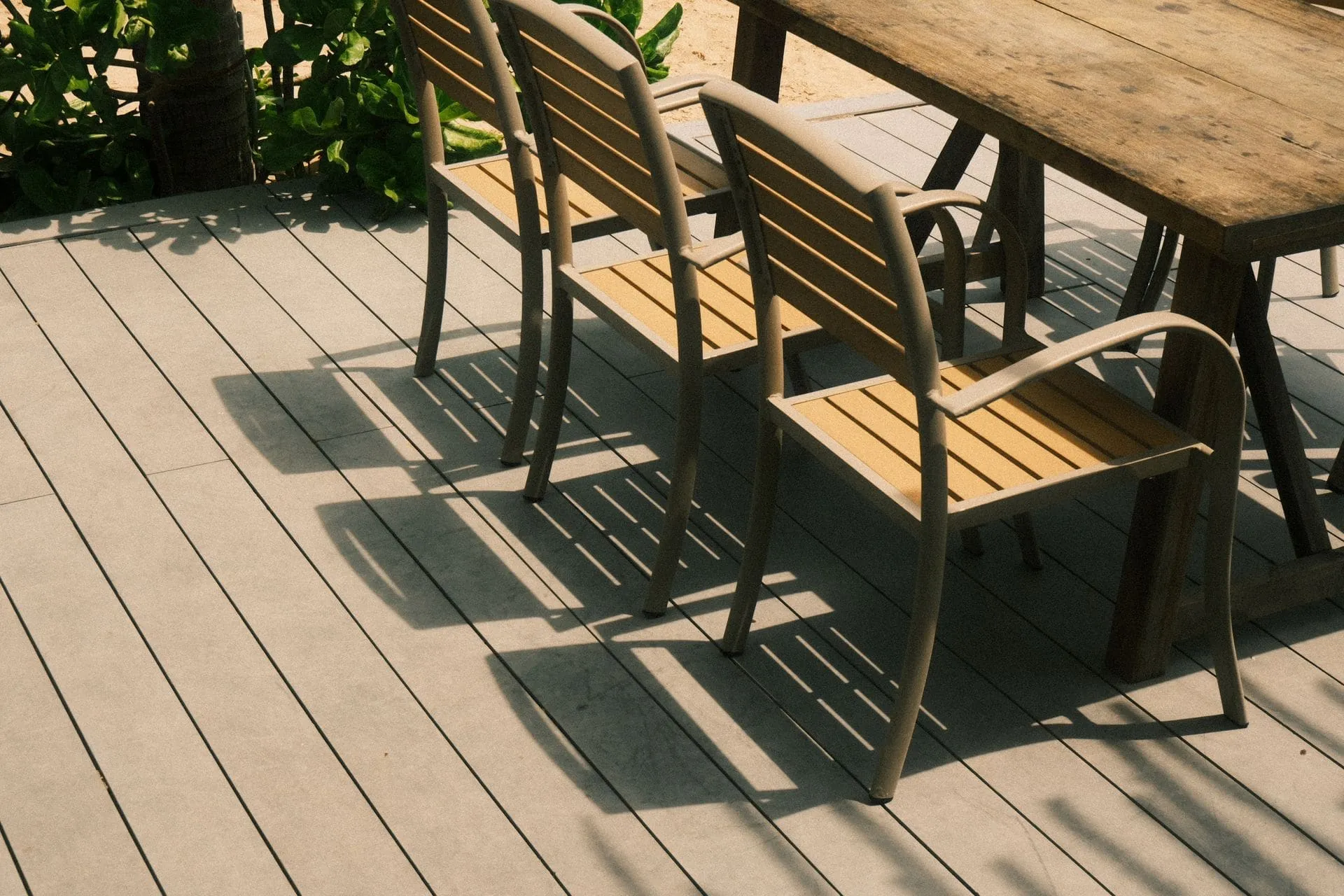
Photo is illustrative. Last updated 8 October 2026.
Composite decking in Adelaide has become a popular alternative to timber for people who want a good-looking deck without the yearly oiling. We design and build composite decks from our base in Brooklyn Park for homes across greater Adelaide, from compact courtyard decks to raised decks and pool surrounds.
Composite is one part of our wider decking service. If you’re still deciding between materials, this page explains where composite works well and where it might not be the right fit.
What is composite decking?
Composite decking is made from a blend of wood fibre and recycled plastic, formed into boards that look like timber but don’t need oiling. Most modern boards also have a protective outer cap that helps resist staining and fading.
Because the boards are manufactured, the colour and texture are consistent from one board to the next. Many ranges include a woodgrain finish, and colours run from pale greys through to warm browns and charcoals.
Why people choose low-maintenance decking
The biggest reason is time. A composite deck skips the cycle of sanding and re-oiling that hardwood needs to keep its colour in the Adelaide sun.
Other reasons we often hear include:
- No splinters, which matters for kids, pets and bare feet.
- Consistent appearance that doesn’t grey off the way untreated timber does.
- Resistance to rot and insects, since the boards are not solid timber.
- Recycled content in many board ranges.
- Hidden fixing systems on many products, which leave a clean surface without visible screw heads.
Composite vs timber: a quick comparison
Composite and hardwood timber both make excellent decks. The right choice depends on how you weigh upkeep, feel and appearance.
| Composite deck boards | Hardwood timber | |
|---|---|---|
| Ongoing upkeep | Wash occasionally, no oiling | Clean and re-oil regularly |
| Appearance | Uniform colour and grain | Natural variation, weathers to grey without oil |
| Feel underfoot | Can get warm in full sun, especially darker colours | Generally stays cooler |
| Damage | Boards are replaced rather than sanded | Can be sanded back and re-coated |
| Frame requirements | Often closer joist spacing | Depends on board size and species |
If you love the look of natural grain and don’t mind regular oiling, our timber decking page covers the hardwood options. For a deeper side-by-side, read our guide to composite vs timber decking.
Choosing composite deck boards for Adelaide conditions
Adelaide’s climate shapes which composite board and colour will work best on your deck.
Colour and heat
Composite boards absorb heat in direct sun, and darker colours absorb more. On a north- or west-facing deck with no shade, a lighter grey or sandy tone will be more comfortable underfoot in January than a charcoal board. Adding a pergola over part of the deck is another good way to keep it usable through summer.
Expansion and gaps
Composite boards expand and contract with temperature, and Adelaide’s swing between cool mornings and hot afternoons makes this noticeable. We follow the board manufacturer’s spacing and fixing requirements so the deck can move without buckling.
Ventilation and drainage
Composite boards and the frame underneath both perform better with airflow. Low decks are designed with enough clearance for air to move, and we plan drainage so water runs away from the deck rather than sitting beneath it.
Coastal and bushfire-prone sites
Near the coast, salt air affects metal fixings and frames, so component choice matters. In bushfire-prone parts of the Adelaide Hills, the materials allowed can depend on your site’s bushfire rating, so not every composite product is suitable everywhere. We check this during the design stage.
Where composite decking works well
Composite suits a wide range of projects, but it really shines in a few situations:
- Pool surrounds, where splinter-free, non-oiled boards make sense. See our pool decking page.
- Family homes with kids and pets who are hard on outdoor surfaces.
- Investment properties and holiday homes, where low upkeep matters.
- Modern homes where a clean, uniform finish suits the architecture.
How we build a composite deck
You deal with one team from your first enquiry through to clean-up.
- Call 0485 008 292 or use the quote form. Photos are welcome but optional.
- We reply within 24–48 hours and book an on-site measure.
- Measure and design. We check levels, access, sun and drainage, and help you narrow down a board range and colour.
- Written, itemised quote that lists boards, framing, fixings, steps and any extras.
- Approvals where needed. Raised decks may need council approval; check with your council or PlanSA, and we can help with drawings and paperwork.
- Build and clean-up. We build the subframe to the manufacturer’s requirements, lay and fix the boards, finish the edges and leave the site tidy.
What affects the cost of composite decking
We quote every deck on its own site and design. These are the factors that make the biggest difference:
- Board range. Composite products vary in quality, capping, colour and fixing system.
- Deck size, height and shape. Raised, multi-level or angled decks need more framing and labour.
- Framing. Closer joist spacing and the frame material both affect the materials list.
- Edges and fascia. Finishing boards, picture-framed borders and steps add to the scope.
- Site access and preparation. Tight access and uneven ground take more time.
- Extras such as integrated lighting, balustrades or a roof cover.
Our article on decking costs in Adelaide explains these factors in more depth. When you’re ready, call 0485 008 292 or use the quote form, and we’ll be in touch within 24–48 hours to arrange a measure.